He experienced the horrors of two wars and during this time he also covered an immense geographical area. The trip described in this blog is an attempt to retrace his steps from Prague across the Eurasian continent to beyond Lake Baikal in Siberia. The first part of the trip will follow the precisely described route of Josef Švejk, Hašek's inspired literary creation. I left home on April 30 2010 and was back on October 29.

Sunday, 25 July 2010

Russen ohne Gewehre

Extract from Hašek's Vormerkblatt which
reports him as missing in action.
This blog entry is partly historical and partly a travel letter. It revolves around Jaroslav Hašek's final farewell to the k.u.k. Heer on 24 September 1915 and the region where it all happened; Volyn in current Ukraine. But I will start with a few notes about some very important documents that have decidedly influenced the contents of the last 3-4 letters.

The reader may by now wonder how I could have produced two detailed historical blog entries about the history of the k.u.k 91st infantry regiment in just a few days in late July 2010, while still travelling and with limited access to internet.  The simple answer is: in fact I didn’t. The blog is now 18 months behind and I go on “cheating” by back-dating the entries to the approximate stage of the trip the letter deals with. The delay is not only for the bad though. Although my experiences from the road are less fresh in my memory in April 2012, I have in the meantime got my hand on valuable historical material that I hadn’t read at the time or even was totally unaware of. Without this, the previous two blogs would not have been possible.

obalkaThree of the new discoveries have been on particular value. The first is a book I was aware of in 2010 but hadn’t read: Jaroslav Křížek’s solid but ideology-infested “Jaroslav Hašek v revolučním Rusku” which Michal Giacintov kindly gave me after my return to the Czech Republic in October 2010. The author was associated with the army and had privileged access to  the Central War Archive in Prague (VÚA). This book was published in 1957 and contained a wealth of hitherto unknown material. His account about Hašek’s period in the Austro-Hungarian army is by far the most detailed I have seen in any book. It is well researched, and  when the reader has filtered away the ideological varnish, what remains is an extremely valuable piece of work. I wrote in an early blog that Pavel Gan’s book was “more important than Lonely Planet”. Křížek’s book is much more than that: it is a must for any haškolog and I really wish I had read it before I set off.

Nor should “Österreich-Ungarns letzter Krieg” be forgotten. It is a mammoth seven-volume account published in Vienna in the inter-war period, extremely detailed and with excellent maps as Beilage. Nowadays these sell for 250 Euro per volume! I managed to get my hands on volume II which covers 1915 until the fall of Brest-Litovsk (August 25), and the rest I downloaded. The 91st regiment is not explicitly mentioned but the book gives a good overview of the events that determined the movements of its parent units: the 17th infantry brigade which was part of the Prague based 9th infantry division.

Page one of the IR91 chronicle
The third discovery is not a book, but a nearly finished manuscript. I visited VÚA (Central War Archive) in Prague for two days in November 2011 and photographed almost 250 pages detailing the history of IR91 from May to November 1915. The title is Das Infanterieregiment Nr. 91 am Vormarsch in Galizien. The author seems to have been an officer in the regiment, it was written in German in České Budějovice around 1927, probably intended for publication but somehow it didn’t materialise. The story is typed on paper from a 1927 Czech calendar, and the typewriter must have been German as Czech diacritics were added by hand afterwards. It gives an unusually detailed account, with dates, places, order of battle, lists of personnel etc. There are even some unique photos, but unfortunately few of them can be related directly to the text. If I had seen these documents before I set off, the route through the Ukraine would definitely have been different, more detailed but it would have taken longer.

On the bus from Lutsk to Dubno
As it was I took a short-cut, more due to ignorance than by intent. I was already aware of Żdżary  but didn’t bother to go there this time. The village was destroyed by UPA in 1943 and is not to be traced on contemporary maps. Instead I set off from Sokal on July 20 after bidding farewell to my hosts Ivan and Maria Strilets. I was determined to go to Dubno, but still hadn’t decided which route to take, so I jumped on a mini-bus to Červenohrad to wait for the first and best. I took the first but not necessarily the best option. It was a customary minibus marked Lutsk. The packed and steaming hot vehicle moved at snails pace along the borders of Lvivski oblast and Volyn, the driver skilfully manoeuvring between the thousands of pot-holes as if he had been doing nothing else all his life. He probably hadn’t. The bus even went back through Sokal!

Map of Khorupan:
Russen ohne Gewehre
When crossing to Volyn the bus started to empty and the journey became almost tolerable. I didn’t stop long in Lutsk and jumped on the first bus to Dubno. This was a much more comfortable journey but it was still a relief to arrive at the comfortable hotel on the square. The room was huge, affordable, but basic necessities (for me, that is) like Wi-Fi was missing. Never mind the unimportant luxuries like 6 towels and variations of soap. The reason for choosing Dubno as my base for the next three days was two-fold: its proximity to Chorupanwhere Jaroslav Hašek was captured and to Zdolbunov where the author in his novel refers to a certain Czech brewer Zeman. Pavel Gan also deals with Zeman’s brewery in his book, although there to my knowledge exist no historical evidence that Hašek ever was there.

The next day I was on a pivotal mission: a visit to Chorupan where Jaroslav Hašek’s life took a dramatic turn in the early hours of 24 September 1915. I regarded myself well equipped for the trip: Pavel Gan had even given me a detailed map of the spot, even indicated where the author was captured and where Lukas and Wenzel fled. I was given two versions of the map: one in German and one in Czech. There was a text snippet on the map that is still imprinted on my mind: Russen ohne Gewehre  and on the Czech one rusové bez pušek; in other words Russians without rifles! It made me shiver; these young men were sent to die for their incompetent tsar and his family without any means of self defence. I can understand that morale was low in the k.u.k army, but it must have been even worse on the Russian side. It is no wonder that Russian soldiers surrounded in droves as early as 1915 and by 1917 simply refused to fight on.

Somewhere here Hašek and Strašlipka were captured
on September 24 1915
Chorupan (Хорупань) is located 15 km north of Dubno but there were no buses going there. So I set out in foot, at a brisk pace. So brisk that I took the wrong turning and soon found myself by the river Ikva by Ivanne, way off track. Without being aware of it, I was almost at Pogorelcy where IR91 was positioned from 9 to 17 September 1915. That was before they withdrew back across the river to Chorupan due to their exposed positions.

I corrected my poor navigation by crossing the fields, through the marshes towards Chorupan, pestered by insects along the way. I found the village but was totally confused by Pavel Gan’s map. I just couldn’t make it fit the terrain and there was no Khorupan where the map indicated. Nor was Mlynov where it was supposed to be or the road to Rovno (Rivne) for that matter. I took photos of the place all over, but was never sure what was where. Later on I found out that the map was based on an account by Jaroslav Kejla who was captured the same day. However, he might be excused for confusing the tourist with the location of Chorupan. Polish historical maps confirm that the village was where Gan put it, but there is wild confusion with regards to directions. My guess is that Chorupan suffered the same grim fate as Żdżary and many other villages in Volyn: a victim of UPA’s campaign of genocide against  Poles in 1943-44.

NB! Хорупань is spelt Chorupan in Polish and Czech, and this is also how it appears on the Austro-Hungarian Military Survey map from 1910. This spelling is also used in the "IR91 Chronicle" and in Österreich-Ungarns Letzter Krieg who both used Polish spelling for place names in Galicia and Volyn.

The smallest "mahasin" in the world is in Хорупань
It turned out to be a very long and hot day. The current village of Khorupan is drawn out on a ridge above the former village. It was obvious that they had not seen many tourists there so I received a lot of attention. I had a beer by the smallest shop in the world, another few in the cafe on the miserable square where I was invited by cafe-owner Viktor. Despite the friendliness and hospitality the visit made me sad. The village epitomised post Soviet rural decay: derelict buildings, awful roads and poverty. The walk back was long and exhausting, accompanied by cows, muck, dust and swarms of biting insects. To my left was the river Ikva where the Russians attacked on that misty morning of  September 24 1915. I should not complain about the insects. There were people who suffered worse on this forlorn spot in Volyn: hundreds of young Russians and Central Europeans fought the last battle of their lives here 95 years ago.

The railway station at Zdolbuniv,
an important hub.
On my final day in Dubno I took the train east to Zdolbuniv (ru/cz Zdolbunov), an important railway junction south of Rivne (ru/cz Rovno). The prisoners were presumably driven here on foot and that they spent some time here is plausible; they may well have been waiting for rail transport onwards. I had a look around the town, and even went to the town museum and asked for the Zeman brewery. The ladies there were friendly but looked as me as if I had just landed from another planet. I guess it is not a daily occurrence in Zdolbuniv that a Norwegian tourist asks  about the whereabouts of a long dead Czech brewer.

Only later did I discover that there was a mix-up, and that it all started with Hašek. There existed indeed a Zeman brewery but not in Zdolbuniv; it was in Kvasyliv 5 km further north. The Zeman family had also “branched off”: in Lutsk Václav Zeman ran a very successful operation that was in business until 1939. The exact connection between the Kvasiliv and Lutsk brewery was the family, but I have not established exactly who the brewer Zeman in Kvasyliv was. It could even be that both breweries were owned by Václav Zeman. The brewery was re-established in 2004, so i DID have a reason to stop in Lutsk after all. But that must be on the next trip. Needless to say the ladies at the town museum were unable to enlighten me on the Zeman brewery.

Friday, 23 July 2010

Volhynia and captivity

Jaroslav Hašek, presumably somewhere in Volyn
On  2 August 1915 the 91st regiments terrible ordeal at Sokal came to an end. Having lost almost half of their man-power they were transferred to new position 15 km to the north, by the village of Żdżary where  they arrived early the next morning. There were disturbing reports of disloyalty in the 11th and 73rd regiment (both Czech): soldiers had thrown their guns away during the fighting, and officers were instructed to execute on the spot anyone caught. The IR91 chronicle also reveals that the village was ridden by cholera and the troops were strictly forbidden to drink the water or eat fruit.

IR91 now joined the reserves along a section of the now relatively quiet front, which went east of the Bug. On 6 August the 3rd battalion was moved east of the river for guard duty by the Romosz farm. On 15 August the 13th march battalion arrived and were greeted by the regimental band. It may seem insignificant, but on the list of names a certain Leutnant Michalek is found. He is by many believed to be partly role model for the moronic lieutenant Dub, Švejk's utterly repulsive counterpart. It is also revealed that Feldkurat Eybl that day held a glorious field mass, a parallel to field chaplain Ibl in Švejk. About Hašek’s own undertakings, little is known from this period. A few of his poems have been preserved - “In the reserve” and “About lice”. It is also evident from official records that he was decorated for bravery on 18 August. On this day a huge celebration took place to commemorate the Emperor’s birthday, and dignitaries from the army turned up. Hašek himself was decorated by Oberstleutnant Kieswetter.

Windmill on fire in the honour  of Franz Joseph I
The celebration also had an unsavoury twist to it that no doubt would have received the author’s attention if the novel had continued this far: the soldiers had the previous night set fire to a windmill to honour the Emperor and King. No doubt the local population was so grateful for the liberation that a destroyed livelihood would be a minor and just sacrifice in honour of the Emperor and his family who had sacrificed so much for them. In reality the Ukrainian/Rusyn population was amongst the least loyal of all His Majesty’s subjects, and upon “liberation” in 1915 thousands of them were executed or sent to the concentration camp at Thalerhof by Graz.

In the meantime Conrad von Hötzendorf and his staff at Armeeoberkommando at Teschen (now Cieszyn/Český Těšín) were busy planning a new offensive. The aim was to push deep into Russian territory before the winter set in and cut the important north-south railway connections between Sarny, Rovno (Rivne) and Tarnopol (Ternopil), and perhaps even reach Kiev.

Historian Norman Stone observes:

Further south, the campaign ended as it had begun with an Austro-Hungarian embarrassment that, again, showed how right Falkenhayn* had been. Conrad had sought to accompany Ludendorff’s Vilna offensive with one of his own, and dreamt of a double envelopment of the twenty-five divisions of Ivanov’s front, from north and south. This took no account at all of the terrain, or the declining quality of Austrian troops. On the contrary, it was billed as ‘Black-Yellow Offensive’ it would carry the Austrians to Rovno, maybe Kiev. As Hoffmann rightly said, the Austrian high command would see sense ‘only when the knife is at their throat’. Ivanov appealed for reinforcements - sending even an eleven-page letter to the Tsar (which he did not read until March) explaining that Kiev mattered a great deal, ‘on account of the increasing numbers of pilgrims going there before the war’. But he was given only trivial reinforcement, and Conrad supposed a great victory was to be had. His troops attacked in eastern Galicia, on the Sereth, and in Volhynia. At first they made reasonable progress, taking Lutsk on 31st August. But the sick-lists rose alarmingly; transport through the marshy valleys was sometimes so slow as to be barely perceptible. Six Austro-Hungarian divisions were also removed to take part in the new Serbian offensive. In Galicia, there was a sudden reverse, with an extraordinarily high number of prisoners taken by the Russians. In Volhynia, IV Army (Archduke Joseph Ferdinand) blundered forward from Lutsk, exposing its left flank. Russians concealed themselves in the reeds and marshes, and attacked this flank between Lutsk and Rovno. By 22nd September 70,000 prisoners had been taken by the Russians, and Brusilov re-entered Lutsk. Falkenhayn had to divert to Galicia two of the Austrian divisions meant for Serbia - they had already reached Budapest - and German troops were turned south to restore the position at Lutsk. In the last days of September, Brusilov retired from Lutsk, and a line was established between it and Rovno. Conrad grumbled, after his strategic genius had once more, in his view, been betrayed: ‘We can do absolutely nothing with troops like this. Something so simple, so easy as what we planned has not been seen in the entire war, and yet we were let down’. Falkenhayn had a different verdict on these Austrian extra-tours: they were an object-lesson for Central European soldiers who thought they could defeat Russia. Austro-Hungarian losses were astonishingly high: between 1st and 25th September their force in the East fell from 500,000 to 200,000, and the proportions of loss were also remarkable - in IV Army, 30,000 ‘missing’, 10,000 wounded, 7,000 sick, 2,000 killed. It was already notable that, in the Austro-Hungarian army, twice as many officers reported sick as were wounded. In the German army, this proportion was reversed. It was good evidence of the different quality of the allied armies. Falkenhayn, not surprisingly, was glad to be relieved of the need to co-operate with Austria-Hungary on the eastern front.

*) Erich von Falkenhayn: Chief of the German General Staff 1914-1916

At Żdżary news about the planned offensive arrived on 24 Augus. The attack duly started on 27 August and the IR91 chronicle reports that they crossed the border 6:45 in the morning. In the beginning the 1st army, which the 9th infantry division was now assigned to, made good progress. We can from the IR91 chronicle, “Das Infanterieregiment Nr. 91 am Vormarsch in Galizien” easily follow Jaroslav Hašek’s route eastwards, as the movements and whereabouts of his 3rd field battalion is frequently mentioned. The battalion was still commanded by Vinzenz Sagner with Rudolf Lukas in charge of the 11th field company. Interestingly the commander of fourth field battalion, major Kremžar, had on September 4 sich marod gemeldet (reported sick). Compare the observations above from Norman Stone on the astounding number of sick officers in the k.u.k army ...

The front on the Ikva and the 91st regiment.
Map by Jaroslav Šerák.
The Russians retreated quickly and by 2 September a line on the river Ikva was reached. The 91st regiment took up positions by Pogorelcy on 9 September. Dubno and its fortress had been abandoned by the Russsians on 8 September, an event reported even in official news bulletins from Vienna. On the way the regiment passed villages like Milatyn, Ulgowka, Torgowica and Mlynów and was involved in several Gefechte on the way. The offensive however soon ground to a halt and the Russians seized the initiative. On 14 September they attacked and the positions at Pogorelcy east of the Ikva had to be abandoned. The withdrawal took place in the night between the 17th and 18th. That night Jaroslav Hašek apparently led the whole battalion across the river Ikva, after he had used his language skill to certify where the ford was. For this deed the three years sentence he carried for desertion in Királyhida was allegedly quashed (Radko Pytlík, Toulavé house, based on information from Jan Morávek, 1924). The 91st regiment and other units from the 9th division now started to dig themselves in by Chorupan west of the river.

Early in the morning on 24 September the Russians attacked the new and still unfinished positions, and again the 91st regiment suffered disastrous losses. Although the Russians were pushed back behind the Ikva that same day, many were killed, wounded or missing. Among the missing were two soldiers from Prague: Jaroslav Hašek and František Strašlipka, friends from the time in the training camp in Királyhida. According to eyewitness accounts from Rudolf Lukas and Jan Vaněk  Hašek was in no hurry to get away, and it is assumed that he simply let himself get captured. From that date traces of him temporarily disappeared, more on this in upcoming blogs.

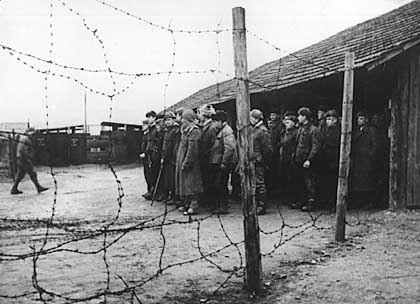
The Austro-Hungarian offensive in Volyn and Eastern Galicia ended in failure and again the losses were huge. This was the last large operation that the Dual Monarchy undertook independently, from now on their forces were placed under German command. With the eastern front now stabilising for the winter, the 91st regiment was deemed surplus to requirements and transferred to the Isonzo-front in Italy. In the meantime Jaroslav Hašek was “safely” interned in a miserable prisoner camp in Orenburg oblast, southern Ural. On 15 November 1915 there was finally a report on his fate, in his favourite newspaper Narodní politika. Here it was reported that author Jaroslav Hašek, the well-known Czech belletrist fell in captivity at the end of September. Through this, according to "Právo lidu", all rumours about his death are disproved.

    Thursday, 22 July 2010

    Carnage by Sokal

    Abwehrkampf einer MG-Abteilung. Maschinengewehrabteilung II des Infanterieregiments Nr. 4
    "Hoch- und  Deutschmeister" auf der Höhe Gora Sokal am Bug, 20. Juli 1915. 
    Karl Friedrich Gsur.
    Sokal is the first place where Švejk would have seen any fighting if he had ever got that far. In Karel Steklý´s film he actually arrives at the front and k.u.k forces are being shelled by the Russians. In this film which has been twisted towards comedy and slap-stick, Lieutenant Dub hides from the shells in a wooden shit-house. This scene has nothing to do with the novel, although some inspiration might have been drawn from Karel Vaněk´s continuation. So, with Švejk now finished, let us therefore return to what the author himself took part in and surely would have found place for in the novel. It is a tale of horror ...

    From VÚA (Central War Archives), Prague. History of
    the 91st regiment (author unknown).
    Hašek and the 12th march batallion had arrived in Łonie near Gologory on 11 July. They had left Királyhida on 30 June and were at arrival commanded by Oberstleutnant Wenzel. Until Sambor the transport was by train. How they moved onward from Sambor to Lonie is less obvious, but we must assume that it was on foot.

    In Łonie the march battalion offset the losses the 91st regiment had suffered during their advance in Galicia from early May onwards. The troops of the march battalion complemented field battalions II, III and IV of the regiment. Hašek was assigned to FBaon III, 11th company. The 91st regiment consisted of 4 battalions of which number II, III and IV were fighting on the Galician front. The 3rd field battalion was commanded by Oberleutnant Sagner and the 11th Feldkompanie by Oberleutnant Lukas.

    Note the similarities with Švejk, but also how the author freely moved formations, ranks, and people around to create his plot. In the novel the number of Švejk's march battalion is unclear, and Švejk's 11th march company seems to have its number and even some of its staff borrowed from Hašek's 11th field company, post Gologory. IR 91 was part of the 17th infantry brigade (IBrig 17) which again belonged to the 9th infantry division (ID 9). To complete the army Schematismus: this division belonged to the Armeekorps XVIII which in turn was part of the k.u.k Second Army, the so-called Heeresgruppe Böhm-Ermolli.


    Situation by the Bug on July 15 1915.
    (from Österreich-Ungarns letzter Krieg).
    After capturing Lemberg (now Lviv) on 22 June, Verbündete forces soon soon reached the river Bug where they consolidated their positions. But by mid-July High Command had ordered a new offensive. The objective was to cross the river Bug, recapture the parts of Galicia that were still on Russian hands and push into enemy territory before the winter set in. Böhm-Ermolli ordered the 9th infantry division (they had been fighting by Gologory) to move north behind the lines into positions by Kamionka Strumiłowa where he planned an attack across the river Bug towards Radziechów (now Radekhiv).

    The division reached the area on 17 July after breaking up from Łonie  on the 13th. It was during this march they on 16 July passed Żółtańce and had a two hour Rast north of town, near the railway station. This break was however too short to provide material for the final chapter of Švejk, so it is likely that the author simply picked this spot from the map and filled in with facts (and fiction) from elsewhere. Otherwise his description of the fighting along the Bug is remarkably precise. After a few more stops the regiment arrived by Obydów on 19 July and it was from this spot they were to cross the Bug. They even started to build a bridge but were hampered by heavy rain. The attack was planned for 21 July.

    In documents in the Central War Archives (Prague) Hašek is listed as Zugsordonnanz,where his duty as a messenger was to connect the squads within his company and to other units as well. This is a function he also assigned to Švejk, but at a much earlier stage. Here we have one of several indications that the author mixed a number of facts, people and experiences from this time in the 11th Field Company into Švejk's time in the 11th March Company. The 11th march company never existed, the 12th march battalion consisted of four march companies, numbered I, II, III and IV (according to Bohumil Vlček, Jaroslav Kejla).

    Description of the situation by Sokal on July 20.
    (from Österreich-Ungarns letzter Krieg).
    Further north by Sokal, units from the First Army had in the meantime crossed the Bug and a bridgehead was established on the eastern bank of the river. Amtliche Berichte from Vienna show that the battle by Sokal had been raging at least since 16 July when the Bernardine monastery on the western shore of the river had fallen. On 18 July German and Austrian troops crossed the river, occupied Sokal as well as the strategically important Gora Sokal and dug themselves in around the town.

    Russian commander Brusilov however soon recognized the vulnerability of the enemy bridgehead and ordered counter-attacks to destroy it.  Gora Sokal (trigonometrie 234, 237 and 254) was recaptured by the Russians on July 20, and Paul Puhallo, commander of the First Army, realized how serious the situation was and asked for assistance that same day. This was to provide decisive for the fate of IR91. With the the rest of the 9th infantry division (IR11, IR73, IR102) they were ordered northwards to strengthen the bridgehead and General Böhm-Ermolli had to abandon his plans for an offensive towards Radziechów. Instead the Second Army was left to "clean up" the area west of the river Bug.

    The situation in Sokal on July 23,
     the day the 91st regiment arrived.
    At 4:30 in the morning of 21 July the 91st regiment left their quarters near Obydów where they had spent the last two days. Another two days of arduous marching awaited them. They marched through Mosty Wielkie where they met Reichsdeutsche units, an event which might have inspired Hašek's description of German troops in Švejk. The weather was very warm those days after weeks of heavy rain. In the evening of the 22nd they arrived in the Sokal area and on 23 July Hašek's III. battalion was amongst those who replaced German troops south of Sokal by Poturcyza.

    With the newly arrived reinforcements, a renewed attempt to capture Gora Sokal was planned, and it duly started in the afternoon of 25 July. Heavy fighting continued for the next few days and the losses were terrible on both sides. In name lists, around half the names on the 11th Field Company have been ticket off as either verwundet, vermisst or gefallen. Amongst the casualties were three out of the four company squad leaders (Zugsführer), only Kadett Hans Bigler came through it unhurt. The 91st regiment managed to reach Kote 234 on the 26th, but Russian counter-attacks pushed them back and 28 and 29 July were black days. The numerical superiority of the enemy started to count. IR 4 (Hoch und Deutschmeister) had to give up Kote 254 and IR 91 had to withdraw to a new line of defence further north by Babiniec. The k.u.k forces were in a desperate situation. Losses were huge, half the 91st regiment were either killed, wounded or missing. Fortunately for them the Russians unexpectedly  started to withdraw on  31 July.

    Sokal and surroundings on a k.u.k military map from
    1910. The contested Kote is 254 clearly visible.
    The Russian pull-out had little to do with the achievements of the Austro-Hungarian forces by Sokal. The foe was still controlling Kote 254, but events further north dictated the outcome. German forces had broken through (general Linsingen), and the Russians decided to withdraw to the river Ługa for fear of being outflanked.

    Several of the officers who later lent their names to characters in Švejk were present at Sokal: Oberleutnant Rudolf Lukas, Stabsfeldwebel Jan Vaněk, Kadett Hans Bigler, Oberstleutnant Franz Wenzel, Hauptmann Vinzenz Sagner. Some of them had striking similarities with their counter-parts in the novel, and they may or may not have been pleased when their names appeared in Švejk! Another vaguely obscured real-life model was Feldkurat Jan Evangelista Eybl, called Ibl in the novel.

    According to "Gefechtsberichte" in Vienna's Kriegsarchiv, Oblt. Wenzel during the battle on July 27 disappeared and "took up position" in the reserve by the 4th batallion. This left the 2nd batallion without a commander, and Oberleutnant Peregrin Baudisch was left with the task. Sagner and Baudisch were both given credit in the same battle report that was issued a few weeks later. There was even talk of taking Wenzel and the IR91 commander, Oberst Steinsberg, to court after the battle. Their behaviour could at best be deemed incompetent, but cowardice is an expression that might be apt under these circumstances.

    In the evening of 2 August IR 91 moved to Żdżary 15km to the north and spent nearly four weeks in the reserve there. Hašek was from 1 August promoted to Gefreiter (lance corporal). On August 18 he and many others were decorated for bravery demonstrated during the battle by Sokal. According to Jan Morávek (Večerní České Slovo, September 1924) he had together with Vaněk captured 300 Russians. These were men who were glad to leave the war behind anyway, so at best Hašek “guided” them into captivity.

    This story has later proved to be rather unsolid. His "Belohnungsantrag" was investigated in 2014 and tells a different story. He was decorated for his effort in delivering orders and reports, as well as having voluntarily undertaken risky reconnaisance duties. Moreover his encouraging of fellow soldiers is mentioned. This happened on 25 July by Poturzyce. It should also be noted that the diary of Vaněk doesn't mention the deed (which he was supposed to have taken part in).

    Sources:
    • Österreich-Ungarns letzter Krieg, Band II, Teil I
    • Das Infanterieregiment Nr. 91 am Vormarsch in Galizien. Type-written document from the Central War Archives (VÚA). Prague.
    • Jaroslav Hašek v revolučním Rusku. Jaroslav Křížek.
    • ÖSTA

    Tuesday, 20 July 2010

    Marching on without Švejk

    “With the Bezirkshauptmann we always used to say: Patriotism, fidelity to duty, overcoming one’s self, those are  the real weapons in war! I am reminding myself of  it especially today when our military troops will in foreseeable time cross the borders.”

    In an abandoned vicarage in Klimontów, these final passages of the Švejk novel were uttered by the perennially moronic Lieutenant Dub, a caricature of a Czech monarchist, albeit one with a certain position in society. His final words makes one think of Samuel Johnson’s famous sound-bite: “patriotism is the last refuge of the scoundrel”. Whether Hašek here was building up to a Johnson-like ridicule of patriotism in general we will never know. The likelihood is that it was the Austrian patriot in particular he mocked, not the dis-united patriots of (the rest of) the  world. Hašek was himself a Czech patriot but was not adverse to shitting in the nest of other patriots (or in anybody's nest  for that matter).

    After this abrupt and tragic end of Švejk it was time to wonder: What is the likely direction the novel would have taken if the author had lived on? Hašek did leave some clues. The advertising posters for the first instalment of Švejk reveals that the plot was also to take place in Russia during the civil war, so we can safely assume that Švejk would continue to follow his creator’s journey, more or less accurately. Another important indication is the farewell scene in Királyhida between Švejk and Vodička. Here it is clear that the author intends his hero to return home safely. An even more direct statement is found in the introduction to Book One. Here Hašek writes that “Nowadays, you can run into a shabby man in the streets of Prague who himself has no idea of the significance he actually has in the history of the great new era”. So Švejk had obviously returned. But where apart from Prague did the author intend his hero to appear? There is only one other place that is mentioned explicitly: Sokal. This is stated both in the chapter header “From Bruck an der Leitha to Sokal” and also later when the soldiers are skinning the “unskinnable” cow in Liskowiec (chapter Marschieren Marsch). This is, however, only part of the story; the pure geographical direction the plot. Just as important (or even more so) is: Who would have been at the receiving end of the authors biting satire hereafter? He had almost left his bête noire Austria-Hungary and there were still nearly three more volumes planned ...

    Naturally Sokal was to become my next stop although I didn´t follow Hašek´s route in detail. That would have meant quite a cumbersome detour via Holohory to Kamianka-Buzka and several smaller places the soldiers stopped at when walking from Holohory to Sokal between 11 July and 22 July 1915. The battle by Sokal raged from 15 to 31 July and Hašek's regiment arrived in the region on the 22nd (more on the battle itself in the next blog entry). The route is described in some detail in Jaroslav Křížek´s Jaroslav Hašek v revolučnim Rusku, but I didn't have the information available at the time.

    Ivan and Maria Strilets.
    Instead of trying to retrace too much of the author's chequered journey, I did a short-cut. From Lviv´s Автостанція 2. I took the by now familiar mini-bus route 80 km north to Sokal. Along the roads there were signs to a few places which readers of Svejk might recognise: Rava-Ruska, Velyki Mosty, Kamianka-Buzka and Sokal itself.

    When I arrived in Sokal that baking hot afternoon I even managed to jump off at the wrong bus-stop. But with remote assistance from Munich (and a huge phone bill), I found my destination in the end. It was Petruševska 47 and the good people receiving the visitor there were Ivan and Maria Strilets.

    This was my third visit to their home. The first was in 2004 on my make-shift Švejk-trip. Their house is on the southern outskirts of town, right by Sokal Hora where some of the fiercest fighting took place in July 1915. I even had a room with a view across to the former battlefield. Although the name suggests a mountain, it is actually a low hill which reaches 254 metres above sea level. The fact that I was staying in this particular house had everything to to do with Pavel Gan who I had visited in Munich back in early May (see More important than Lonely Planet). Maria and Ivan are in fact his parents in-law. The lady in Munich who had guided me there by phone was their daughter Larissa.

    Sokal hora
    Sitting there watching cooling rain-showers sweep across Sokal Hora, it was time to ponder the improbable chain of events that led me to this spot on earth in the first place. These are important events as they also (partly) explain why I’m doing this six-month trip at all.

    I don't remember exactly when I got it into my head to do a Švejk-trip, but I recollect how I was inspired by maps in Cecil Parrott’s translation of Švejk. Preparing for the trip in 2004 I set about locating the spots I found on Parrott’s map. This proved to be an enormous challenge, particularly in Galicia. I was at the time unaware of the misspellings in the novel, and I knew little about name changes that had taken place since. Places in the Ukraine (names written in Cyrillic) further complicated the issue.

    I started off by Googling, but without much luck. Still, the omnipresent search-engine led me to the web-sites of Zenny Sadlon (zenny.com and svejkcentral.com).  I sent Sadlon an e-mail and although his geo-awareness didn’t extend to Galicia of 1915 he kindly forwarded what was to prove an immensely useful e-mail address; that of Pavel Gan. I wrote to Pavel and although I didn't get the specific geographical information I asked for, I got a lot more: photos, the story of his own research on Hašek and an invitation to visit his wife and in-laws in Sokal during the course of the journey. So I did, and this invitation indeed had a lot to do with my stay at Petruševska 47 now in July 2010. It was also from Larissa and Pavel  I heard that the Hašek family had taken over Česká koruna at Lipnice. On hearing that I decided to pay the venerable hostelry a visit. Without that visit I would never have been invited to the 2008 Hašek-conference, and would never had got the inspiration to carry out this journey. The circle was complete.

    Pavel Gan by Sokal hora, a few years back
    Pavel Gan also has another connection to Sokal. The following information is extracted from his book “Osudy humoristy Jaroslava Haška v říši carů a komisařů”, (epilogue) where he explains how he got so captivated by Jaroslav Hašek.

    Gan’s father was born in nearby Borjatyn and was a serving soldier in the k.u.k Army. Just like Hašek he was a one-year volunteer, but apart from that his career took a different course. He was loyal to the Dual Monarchy to the very end, and Gan puts in a good word for Austria-Hungary in this section. According to Gan his father and his fellow Ukrainians were far better off than in Imperial Russia where a decree from prime minister Stolypin (1910) stated that no Ukraine or Ukrainians existed. Instead there were was the interesting entity "Little Russia", which was incidentally inhabited by “Little Russians”. It should be noted that the term Little Russia was commonly used at the time, even by Ukrainians (JH). 

    Gan also describes the Dual Empire’s enlightened rule of law which compared favourably to both contemporary and future regimes in the region. After the war, Gan’s father emigrated to Czechoslovakia, where Pavel was born in 1933. Due to their Jewish roots, the family had to move several times from 1938 to 1945. Gan’s interest for Hašek started in the fifties during his studies in Brno. One of his main themes is how the communist authorities filtered information about the author to make him fit the image of a good communist. Gan has himself dug out a lot of information that contradicts this view. This is evident both in his book and also in the papers he has published.

    The two days in Sokal were spent walking around town and not the least eating! I felt I never had the slightest chance to even get slightly hungry. Maria complained I was too skinny and when I was starting to get full I heard the the words “ješč” and “davaj” and I understood that I was supposed to be hungry still, and had to make it good by another portion of vareniky, salat and kura
    The ruined synagogue

    I had plenty of time to visit the former synagogue where IR 91 had their HQ in July 1915 (not confirmed, JH 2012). Nowadays it is a sad sight and another chilling testimony to the Holocaust.

    Of interest is also the Bernardine Monasterry which now serves as a prison. On 16 July 1915 k.u.k forces captured the monastery, an event which was reported even in official Berichte from Vienna. Kote 254, the summit of Sokal Hora, is still there of course. The hill is mainly scrub-land and was a very peaceful spot early that July morning in 2010.

    It was hard to imagine that this was hell on earth exactly 95 years ago, a carnage which killed and maimed thousands of young men, mainly from Vienna (IR.4 "Hoch- und Deutschmeister") and Bohemia (IR91 "Papageienregiment"), not to mention the Russian 8th Army. Jaroslav Hašek was amongst the lucky ones who survived, but unfortunately he didn't lived long enough to tell his story.

    Sunday, 18 July 2010

    Meta-text about a meta-text

    Every major literary creation produces secondary literature which in sheer volume often surpasses the original text many times over. These meta-texts (text about the text) can roughly be separated in two categories: interpretation and fact-finding. The first discipline is generally carried out by literary experts whereas the second is more the domain of historians, both professional and amateurs. I consider myself belonging to the latter group and I have spent endless hours digging out historical and geographical facts and pseudo-facts on which backdrop Jaroslav Hašek created his epic satire. The result is a web-project which is far from finished. The database will in the end contain over 800 geographical entries and nearly 600 biographies on real as well as fictive persons. Švejk also contains other items that could be categorised: literary references, food and drink, ethnic groups, military terms, obsolete terms, historical events, just to name some of the possibilities.

    Literary historian Antonín Měšt'an
    One of the most important sources for my web-based “factography” on the Švejk novel was written by Antonín Měšt’an of Universität Freiburg in 1983 in connection with the 100th anniversary the of author's birth. It is an impressive study titled: Realien und Pseudo-realien in Hašeks "Švejk". It filled out many of the holes in my own data, and also gave valuable insight into the novel's misspellings, and how it could be fruitful to start working from the facts given about a certain item, rather than using the written name as the starting point.

    Hans-Peter Laqueur had then already made me aware of another of Měštan’s studies, Ještě jednou o Švejkovi. in: Proměny (New York) 19 (1982) Nr. 1, 25-28. With this paper Antonín Měšt’an provides a detailed study on the chronology of The Good Soldier Švejk. Although the paper also covers other themes, I will spend the rest of this blog entry commenting on Měšt'an's analysis of time-related aspects of the novel. I hope this can serve as a complement to Měšt'an's study.
    Accuracy of quotes
    As much as I had appreciated Realien und Pseudo-realien, the bigger was my disappointment with Ještě jednou o Švejkovi. It starts off worryingly as early as the summary of the plot: at times it seems that Měšt'an hasn’t read the book properly. There are a surprising number of mis-quotes, for instance that Bretschneider led Švejk directly to the Salmova ulice police station, and that the regiment walked all the way from Palota to the front. A further problem is that many historical facts of significance have been overlooked, leading to the erroneous conclusion that the plot in Švejk is chronologically consistent with historical events.
    From Sarejevo to Mödling via Střelecký Ostrov
    Měšt'an's analysis works its way from the few dates quoted in the novel: 20 December 1914 and 23 May 1915 and also draws on cited and verifiable historical events that run parallel to the plot. Amongst these are 28 June 1914 (Sarajevo assasination) and 29 July 1914 (declararation of war on Serbia). Up to December 1914 the study is convincing. Still it could have been noted that Dr Bautze had already served 10 weeks when Švejk appeared at Střelecký ostrov, and we could from that assume that he was called up in October 1914. Another odd timing discrepancy occurs (unrelated to the plot): Obrlajtnant Witinger ran 40 km Vienna-Mödling in 1 hours 48 minutes, a pseudo-marathon record that has yet to be broken.
    Wendler and Lukáš
    Hašek moved the events at Klosterhoek back at least
    four months.
    The next quoted date is 20 December 1914 when Lukáš and hop-trader Wendler have their conversation which involves an impressive array of references to places, breweries, battles and real historical events. Lukáš informs Wendler that Liman von Sanders has been appointed commander of the Dardanneles army. This only happened later, in March 1915. Wendler then reels off the names of places related to battles where  breweries have been destroyed: Klosterhoek, Coimbres, Woevre, Niederaspach, Lamarche, Mulhouse, Vosges. Official war bulletins from early April 1915 all mention these places. My assumption is that Hašek simply copied these names from newspapers or other material he had at hand, mixed them into the plot and freely moved the events back a few months. It seems unlikely that he remembered such details 6 years after: details from Wendler's desperate tirade are almost word for word identical to weekly war summaries printed in Národní Politika on 4 April and 11 April 1915. There is another anomaly in this part of the novel. Wendler exclaims: "What about San Giuliano? Is he asleep or what?" Count San Giuliano died on 16 October 1914 so he was clearly “asleep”. Was this a deliberate pun by Hašek or simply careless use of facts?
    Mishaps on the train
    On the train from Prague to Tábor there is a further chance of hooking the plot up to real life, which escaped Měštan. Lukáš reads in "Bohemia" about the German submarine 'E' which has great success in the Mediterranean. Here he would have discovered that there where no German U-boats in the Mediterranean in 1914, and if there had been any they would have been called something starting with 'U' and followed by a number (Hans-Peter Laqueur).
    Anabase
    Švejk was in Putim twice on his anabasis.
    The famous "Švejkova budějovicka anabase" has no reference to concurrent historical events so there is no problem whereas to when it started and ended. The problem is more its duration. Měštan concludes that our hero walked 200 km (Jaroslav Šerák estimates 160). I did a retrace of the route in 2010 and there is no way that it could have been done in 72 hours as Měštan concludes. It is possible to walk 67 km in 24 hours of course, but Švejk also slept in the Schwarzenberg shep-house and spent a long time at Putim gendarmerie station. Back in 2010 my aching feet made me painfully aware of Hašek's disregard for time and space.

    Měštan's three day estimate is logical based on the description in the novel, but he and Hašek have ignored the physical limitation of Švejk's undertaking. Nor does he note that the route described in the novel does not correspond to what Švejk later described during interrogation. The departure from České Budějovice seems to be related to a specific event: there is talk about the execution of Josef Kudrna, which happened on 7 May 1915. This indicates that the author already has aligned Švejk’s journey with his own. According to local newspapers the replacement battalion of the 91st infantry regiment left for Királyhida on 1 June (the dates given by Pytlík, Vlček and Kejla vary but are all in May). As we shall see this chronological “alignment” was briefly cancelled in Budapest. Radko Pytlík also mentions this anomaly in his book Kniha o Švejkovi. 
    The War Grave Commission
    The next discrepancy between the timing of the plot and historical events takes place in Budapest. The date here is exactly given: 23 May 1915 and Italy has just declared war on Austria-Hungary. The company was given post-cards with war grave motives from Sedlisko (Siedliska) instead of the promised 15  deka of Emmental cheese. The war cemeteries are made by the "shirker one-year volunteer Scholz" (Heinrich Scholz). The problem is that the cemeteries at Siedliska didn't exists at the time. Siedliska had just been liberated, and the war grave commission was only instigated in November 1915. The post-cards may have been printed even later, probably in 1916. This is another example of Hašek not bothering with aligning his "realia" with reality. Again Měštan overlooks this in his timing analysis.
    The long trip to Sanok and Marschieren Marsch
    In Sanok it is reported that they are 150 km behind the lines which stretch from Brody to Bug and onwards to Sokal. This was the situation at the front in early to mid-July, not the end of May. So somewhere between Budapest and Sanok five weeks have disappeared without a trace.
    Between Sanok and Tyrawa Wołoska,
    not the Galician flatlands.
    Onwards from Sanok the timing impossibility from the anabase repeats itself. To start at Sanok 17:30 and arrive in Liskowiec (Liskowate) the same night is physically impossible for anyone but a marathon runner. The march battalion had horse-pulled carts, the roads were bad, they could not possibly have done it like the novel describes. Also, they had been sitting on a train for about a week and had to get used to marching again. A further note of interest from Liskowiec is that the cherries are ripe, very unlikely at the end of May.

    This chapter also contains anomalies with respect to geography. There is talk of the "Galician flat-lands with mountains to the south" just after Sanok, but the area is actually very hilly. The soldiers are said to have followed a stream down to Liskowiec, but the village is right on the watershed. The catholic vicarage didn't exists, at least not around 1890. There is also a reference to a zamek (chateau) in Krościenko, but none seem to have existed.

    This paves way for the hypothesis that the chapter may have been moved not only in time but also is space. Jaroslav Křížek and Radko Pytlík both claim that Hašek's company actually took this route, but provide no evidence. Did the author actually take inspiration from his experiences further east in Galicia where the landscape is flat with the Carpathians to the south and get the geographical detail for the chapter from a map? To further support this hypotheses it should be noted that in "The Good Soldier Švejk in Captivity", the march battalion travels all the way to Sambor by train. This version is actually more credible as the author presumably had less material available when he wrote it and thus relied more on his own experiences (and memory).

    On 26 November 2012 accounts by Jan Morávek finally became available to the author of this blog (based on conversation with Rudolf Lukas and Jan Vaněk's diary) and Bohumil Vlček. These confirm that the 12th march battalion of IR. 91, as one would expect, travelled to Sambor by train. It is not even clear if they ever visited Sanok, probably not. Their accounts are supported by documents from Vienna's "Kriegsarchiv".

    In 2014 Jan Vaněk's priceless diaries very discovered in Kralupy and confirms the route, and adds: departure from Királyhida 30 June 8:15 PM, stop in Humenné 2 July, approaching Sambor 4 July by train.
    Švejk captured
    Švejk can not possibly have been in Przemyśl on 3 June like Měštan concludes. The city was in Russian hands until that very day. He has also ignores the report from Przemyśl that Švejk was captured on “the 16th this month”, presumably meaning 16 June. The latter date could have been possible, the area around Felsztyn (Skelivka) was reconquered already in mid May. The assertion that Švejk arrived in Żółtańce in mid-June likewise ignores the historical circumstances. Lemberg (Lviv) was reconquered by the Austrians on 22 June, and Żółtańce the next day.
    Did Hašek intend to let Švejk catch him up?
    When preparing the wretched cow in Liskowiec it is clear that the plot is going to catch up with the real world at Sokal, i.e from 22 July. Hašek himself arrived at Żółtańce on 16 July. We must assume that Švejk and his author were by now "synchronised". One of the chapter headers also read "From Bruck an der Leitha to Sokal", a further indication of the intended direction of the plot.
    Conclusion
    Antonín Měšt'an attempts at analysing the information of the time sequences in the novel is appreciated but far from convincing. He concludes that the plot is logical and coherent from a chronological point of view, which is clearly not the case. This conclusion further cements Hašek's reputation as an author who paid extreme attention to accuracy and historical details. His reputation in this respect is probably exaggerated, something that Cecil Parrott pointed out in his his book "The Good Soldier Švejk and the short stories": "Hašek wrote carelessly and hardly bothered to proof-read his own manuscripts".

    The main impression is that Hašek didn’t care much about chronology at all, and that Měšt'an fails to notice this. The plot is hooked up to specific dates only three times, whereas there are around eight hundred geographical references throughout the novel. This speaks volumes about the author's priorities with regards to references.

    Hašek would surely also have ridiculed Jomar Hønsi and other meta-text authors who tend to interpret his satirical tour de force as more of a historical document than it really is.Analysing people and places in Švejk is difficult enough, attempting the time-line can only partly make sense. There are just too many contradictions. Still Antonín Měšt'an's paper is an interesting contribution to the studies of the "realia" behind Švejk.

    Saturday, 17 July 2010

    Orange flags

    This blog-entry is entirely off-topic. It refers to events that took place in western Ukraine during WWII. An excellent introduction to this part of history appeared in New York Times in 1992. Jaroslav Hašek never lived to experience the OUN/UPA underground fighters, but from his time in the Red Army he would have been familiar with their opponents NKVD, or rather their predecessor, the Cheka. In the final chapter of Švejk, Hašek touches on the ethnic conflicts in Galicia which were later to lead to the tragedies described below.

    An enigma solved

    Vasyl Pazynyak in 2010
    One morning in July 2010 I met Vasyl Pazynyak (Василь Пазиняк) who I had got to know six years earlier in this same city, in Lviv. That morning Vasyl took me to a mahasin, bought some horse-meat and we sat down in the garden of a pub behind my ugly hotel to enjoy the meat and a few Ukrainian Staropramen. Six years ago I had taken part in a some celebration, and for six years I had been in the dark where I actually had been that day in 2004.

    Pointing at my map Vasyl revealed where it was: the place was called Pyriatyn (Пирятин), a tiny village near Rava-Ruska (Рава-Руська) on the Polish border. In 1944 a little known atrocity had taken place in that village and since 2004 I had searched the internet for information, browsed maps, asked experts, all in vain.

    19 August 2004

    Пирятин memorial chapel.
    That date will stick in my mind forever. I was on my first Švejk-trip and was spending a few days in Lviv. I had been put in contact with Vasyl and Anna Korol who both had been busy most of 18 August, showing the tourist their city. I didn't know their language, so it was for me merely a visual experience. It is mentally exhausting to try to concentrate and listen to a language when most of what was said was guesswork. It may sound ungrateful but I was relieved to be left alone when the day was over. That said, I appreciated the generosity and friendliness. It was also clear that I had been invited to some event the next day but for this illiterate foreigner it was impossible to decipher exactly what this was about.

    Despite my unequal struggle with the Ukrainian language I duly turned up by the Львівська обласна рада (Lviv Regional Council) the next morning. Dr Pazynyak was a council deputy and I was led to a chauffeur-driven white Volha limousine where we all took our place. Off we went out into the countryside. I was dressed as a tourist and suddenly became acutely conscious of it, sitting in my shorts and sandals in an official limousine from Lviv oblast, being transported at the expense of Ukrainian tax-payers. After about an hours drive we took off onto a minor road and ended up by a small chapel in an opening in the pine forest. I still didn't know where I was, but judging by the number of people there (and how they were dressed) it was an official occasion.

    Religion and politics

    The place seemed to be called something like Pyriatyn and people in national customs appeared everywhere. Blue and yellow Ukrainian flags were flying and to my surprise there were also many elderly men in uniforms. Several other flags were waved, and particularly conspicuous was a red and black one. Then there were orange banners decorated with for me incomprehensible slogans, written in Cyrillic script. In the scorching heat a religious service got under way (I assume it was Greek Catholic). I understood that it was some extraordinary  event, as there were tears in the eyes of the old babušy and the uniform-clad veterans. I was told that the men in green were patrioty and that the black and red flags was that of UPA, an entity that on 19 August 2004 for me was entirely unknown.

    After the end of the religious service there were speeches held by politicians; first Vasyl and then a deputy from the national parliament in Kiev. The deputy soon became agitated and I picked up the words kriminalny banditsky klan. It was by now clear that the religious service had metamorphosed into a political gathering. Orange banners appeared in numbers and I was explained the meaning of the slogans, of which the most visible one was Tak! Ющенко (Yes! Yushchenko). Who the latter was I still didn’t know but it was obvious that the criminal gang of bandits was the regime of Leonid Kuchma in Kiev, and that this Yushchenko who we were saying Yes! to was an opposition politician and an altogether cleaner man. The rest is history of course but I had no ideas of the significance of it at the time …

    Vasyl speaking by Пирятин, 19 August 2004.
    As the speeches ended, another transition occurred. The Горі́лка (vodka) started to flow, huge amounts of food appeared and people gathered in groups in the forest to sing songs about “Ukrainské lesy” (Ukrainian forests), “Naše Ukraina” (Our Ukraine), and “Volyn”. An older man, also called Vasyl, was so engulfed in patriotism and horilka that he inadrtently stepped onto the tomatoes and eggs on the blanket in front of him, loudly declaring his reverence for his dear motherland. The Ukrainian hospitality which I since have learned to appreciate was on full show. The guest was treated like a king even though a lady wondered why he was so “nirepresentantny” (unrepresentatively) dressed. In the forest there were groups of people enjoying themselves, eating, drinking and singing. A man, pointing at some singing and mead-drinking women, told me that drinking mead would make you mad, make you sing, and even make you fart (med, med, prt, prt).

    I still had other things to ponder; it wasn't clear to me why a religious service and political gathering was held in such an unlikely place. That it had to do with events 60 years ago I had grasped, but not exactly what. But during the service the grim faces and the tears in the eyes of the old babušy and dědušy revealed the gravity of it, and it soon became clearer: an atrocity took place here back on 19 August 1944. Amongst the people participating today were survivors of a massive crime, almost all of them had lost relatives, mothers, fathers, brothers and sisters.

    Ignorant tourist dragged into politics.
    We were soon taken to a banquet in the village hall, and for I while I feared that I would drown in a sea of horilkaand hospitality, but thanks to copious amounts of food and pickled gherkins I kept my head above water. There were more speeches and Vasyl presented the unlikely guest from Norway, and induced me to hold a short speech. I was petrified, standing there nirepresentantny dressed, but obliged. I thanked my hosts for the hospitality and was given a hint that I ought to round it off with a few choice expressions: Slava Ukraini, Za svobodnu Ukrainu a za Yushchenko. I had no problem with toasting to a free Ukraine of course but I still didn't know who this Yushchenko was...

    The return of NKVD

    The list of victims.
    The whole day had been a genuinely moving experience and there in the village hall I finally understood why we were here. On the wall there was a exhibition commemorating the tragedy that took place 60 years ago on this day. The Red Army had driven the enemy out of western Ukraine and Pax Sovietica was reintroduced. But not before the NKVD-troops following in the rear of the regular army had performed their “clean-up operations”. That meant punishing anyone who was suspected of co-operating with the enemy, whether it be the Nazis, the Ukrainian Insurgence Army (UPA) or even the Polish Home Army, Armia Krajowa (AK). The village didn't know what horrors were in store for them that day. The men were rounded up and executed, branded as counter-revolutionaries and fascists. Only those who happened to be out working on the fields survived. The number of victims totalled 68. This was to teach UPA-sympathizers a brutal lesson and it is just one of many atrocities NKVD-troops committed during the re-conquest of western Ukraine that year.

    Banderivtsi

    UPA veterans at Пирятин, 2004.
    Even there in the village hall I didn't know what this organisation UPA with it’s black and red flag was, an organisation who is obviously held in high esteem in western Ukraine.

    But after my return home I started to investigate who the people with red black and red flags were. Slowly a sinister picture emerged. The Organisation of Ukrainian  Nationalists (OUN), was created as a reaction to Polish repression and discrimination during the inter-war period. They carried out acts of sabotage and assassinations, both against prominent Poles and moderate Ukrainians. The aim was an ethnically clean, totalitarian Ukrainian nation state. The Polish reaction was heavy-handed; collective punishment hit whole communities, an act that further fueled animosity between the two peoples. OUN obviously were in conflict with the Soviet Union as well, but were less effective against the more ruthless Stalinist regime. After the Soviet invasion of Galicia in September 1939, the OUN leadership, headed by Stepan Bandera fled to Kraków and for the next four years they co-operated with Nazi Germany whose ideology they to a degree shared.

    The Nazi invasion of the Soviet Union on 22 June 1941 led to another twist. ONU declared an independent Ukraine, but the leaders were immediately arrested and deported to Germany. Bandera himself spent the next three year at Spandau prison and in Sachsenhausen. The Nazis would not tolerate a rival centre of power, but OUN and the Nazis still continued to co-operate. In 1943 UPA, the armed wing of the Bandera faction of OUN, was formed. Armed resistance against the Nazis became widespread. Banderivtsi also carried out massacres on Poles in Volyn and Galicia. There were armed encounters with Armia Krajowa, who in turn killed many  Ukrainians. Czechs were also among the UPA victims in Volyn, so were many ethnic Ukrainians. The Polish question is perhaps the darkest chapter in OUN's violent history. Its members also took part in massacring of Jews, although it has been claimed that UPA also had Jewish members. It adds up to a tragic and confusing picture, with shifting and opportunistic alliances, where your enemy’s enemy is your friend, but a friend who the next day may have turned into en enemy. Still it is difficult to have any sympathy for OUN: the ideology and brutal deeds of the Bandera faction of OUN makes up an extremely obnoxious brew.

    In 1944 the Red Army drove the enemy out of the Ukraine and NKVD troops were left fighting UPA, inevitably killing civilians in droves like they did in Pyriatyn. From now on UPA again co-operated with the retreating Germans. They also started to work with their arch-enemy Armia Krajowa against the even greater NKVD evil. There could have been no clean hands in this tragedy, which has some similarities with concurrent events in Yugoslavia. The outcome was by now given, whoever UPA aligned themselves with. The organisation was slowly liquidated by Soviet and Polish forces, but scattered groups were active as late as the early 1950’s. The final chapter was written in 1959 when Stepan Bandera was killed by the KGB in Munich. He is buried there.

    OUN had no natural allies, as none of the powers at the time shared their goal of an independent Ukrainian state. The Bandera group still has few sympathisers outside the Ukraine except for in certain emigrant circles in North America.  Bandera and his followers are a highly divisive force in the Ukraine, where he by many in western Ukraine is regarded a hero but is equally reviled in Russian speaking Eastern and Southern Ukraine. One of the last acts of former president Yushchenko was to declare Bandera a hero of the Ukraine. This happened in face of protests both in the Ukraine and abroad. A court even declared the nomination illegal. His successor Viktor Yanukovych revoked the nomination soon after he came to power.

    Lviv, sixty-six years later

    GULAG, the fate of millions, including Vasyl's relatives.
    As I was sitting there with Vasyl and having pin-pointed the place where we went that hot August day in 2004, he told me about the fate of his father. When the archives were opened in the 1990’s Vasyl finally found out. His father and other family members had been arrested and deported to Siberia. Their crime was that they were kulaks, they might have had one cow too many to be classed as worthy peasants and prospective model Soviet citizens. Thus they landed in the category “class enemies”. Whether the arrest had happened after the Soviet invasion of Poland in 1939 or on the return of the Red Army five years later wasn't clear to me. Their destination was a village by the town of Zima in the Irkutsk region. They journey had taken one month, on the carriages was written “Ukrainian bandits” and the wagons were pelted with stones and whatever was at hand for the on-lookers at the stations. They had been away for 10 years. Vasyl had visited the village by Zima recently and had met many  chorosyoe ljudi (good people) there, emphasising that moskali were as much victims of Stalin and Beria as anyone else.

    We were soon joined by another member of the delegation to Pyriatyn in 2004; Dr. Anna Korol. I was even invited to her hospital but soon got tired of worn corridors, pretty nurses, and sick people, so I went back to my favourite spot Hasova Lyampa to do some work with my dearest friend, my Asus net-book.

    Moskali

    In the afternoon I met Vasyl and Anna again for a meal in a most unlikely place. Opposite the town hall we went through an unmarked door and there was a soldier in UPA uniform asking if I was a moskal and communist. “No”, I said, “I am a Norwegian spy”. Then he brusquely asked for the haslo (password). I had been told earlier by Vasyl what to expect and obliged with Slava heroii!, Slava Ukraini! and Smrt moskalam. Hailing the Heroes, the Ukraine and declaring  ‘Death to the Muscovites’ did the trick. A book-reel opened and we were let into the hideout cum restaurant in the basement. On the menu were interesting items like jazyk moskala (tongue of a Muscovite) which was an enormous sausage. The guest could also have ordered drunk carp-looking moskal and a wider assortment of highly political dishes. This theme restaurant is called Криївка (Kryivka), a term for an underground bunker.

    Kaiser dreimal hoch

    Franz Joseph I, portrait in a cafe in Lviv.
    That sausage with the unlikely name rounded the day off. I had enjoyed myself yet again in Lviv but also had a few more things to think about. In retrospect the fall of Austria-Hungary proved to be a disaster for this part of the world, a disaster it has only recently recovered from (some would say it still hasn’t). By the amount of Habsburg memorabilia and nostalgia found around Lviv it seems that quite a few are ready to regard the Habsburg era as a golden age.

    Today the wounds between Poland and Ukraine have healed considerably. When Bandera was declared Hero of the Ukraine the Polish government diplomatically referred to it as an internal matter. Voices from Russia, Jewish spokesmen and even the European Parliament were less conciliatory. Poland and the Ukraine are soon to host the EURO 2012 football championship together. One of the host cities is Lviv...