This letter is an attempt at describing the complex political and military situation in Russia at the time of Jaroslav Hašek’s release from captivity in June 1916 .
RUSSIA 1914
 |
| Jaroslav Hejduk, the standard bearer of Družina. |
The Russian Empire of 1914 counted around 100,000 Czechs and Slovaks residents, the overwhelming majority of them Czechs. Most of them were Russian subjects, but there was also a number of Austrian citizens. The outbreak of war caused consternation in their ranks as they were as citizens of an enemy power subjected to confiscation of property and even deportation. It became paramount to prove themselves as loyal citizens, and after meetings with higher authorities (even the tsar), they were allowed to create
Česká Družina, a unit of volunteers that was to operate within the Russian Third army.
Initially their headcount was a mere 750, split across three companies. The creation of the unit was formally approved on 20 August 1914, and it became operative during October. They were sent to the Carpathians, mainly to carry out reconnaissance, propaganda and infiltration activities. In the beginning officers were Russians, with Czechs gradually entering amongst the lower ranks. Still as late as 1917 all regimental commanders were Russians.
At the end of 1914 prisoners of war were allowed to joine, provided that the applied immediately after the capture. There was initially concern about allowing them into the Russian army as this was regulated by the Geneva convention. In the first group of 300 prisoners that enlisted in December 1914, there was a very prominent person.
Bohdan Pavlů was a young Slovak intellectual and from 1915 he became editor of
Czechoslovák in Petrograd, and take up an important role in the Czechoslovak movement in Russia. After the war he held positions in the diplomatic service.
Družina was on 2 February 1916 formally renamed the
Czechoslovak Rifle Regiment and on 17 April the
Czecholovak Rifle Brigade and was split into two regiments. In June 1916 the number of volunteers was still only 1500, but in August 1916 a new influx of volunteers from the prisoners ranks were added, and the regiments now counted 8 companies each. The unit was later to form the core of the
Czechoslovak Army Corps (after the war generally known as the Czechoslovak Legion).
CZECH/SLOVAK POLITICAL ORGANISATION
Meanwhile Czechs and Slovaks in Russia started to organise themselves politically. The
Union of Czechoslovak associations in Russia (
Svaz Čs. spolků na Rusi) was founded in Moscow in March 1915. The political leadership located in Petrograd, and this is also where they founded and published their own weekly
Čechoslovák.
The term "
Čechoslovák " itself is worth study in its own right. It was used already early in the war, although almost all the leaders and members of these organisations were Czechs. The Czechs made up more than 95 per cent of the total headcount. Of the original 750 members of
Družina, only 7 were Slovaks. In the Slovak language the word "
Čechoslovák" is generally hyphenated, giving the impression that the Slovaks were more on equal terms than they really were. Politics and language will forever remain inseparable...
 |
Josef Dürich: betting on the
loosing horse |
Other large Czech communities in Russia were found in Moscow, Warsaw and Kiev. The latter group was particularly numerous and was the one closest to the centre of military operations. The leadership of
Družina was thus based in Kiev. The Kiev group was controlled by resident Czechs, which were mainly conservative and loyal to the tsar. The Petrograd group on the other hand, consisted of many former POW's, amongst them
Bohdan Pavlů, leant towards western democratic ideas. From February 1916 these were aligned with the newly created "Czechoslovak National Council" (
Českosloveská Národni Rada).
The council, based in Paris, was headed by
Tomáš Masaryk, the architect and undisputed leader of the Czec/Slovak independence movement. Masaryk had gone into exile in 1914 and immediately started to organize the Czech and Slovak resistance abroad. He was himself of mixed origin, a Czechoslovak in the true meaning of the word. He had until 1914
not advocated the break-up of Austria-Hungary, advocating a federal solution giving the Slavs parity with Austro-Germans and Hungarians, but the new situation made him change his mind.
In the spring of 1916 there was an acrimonious split amongst the Czechs in Russia. The Kiev group took control of the "Union", the Petrograd group was marginalised, and the influence of the
National Council reduced. The Kiev faction started to publish "Čechoslovan" (the first issue was on 2 April), a weekly that had gone out of business at the beginning of the war, but until then had been the only Czech-language periodical in Russia. From Paris the
National Council dispatched
Josef Dürich to reassert their authority, but instead he aligned himself with the Kiev group, advocating a Romanov prince on the throne of a future Czech/Slovak kingdom. The leadership of the "Union" was transferred to Kiev. It should be added that the squabbling was not only about political direction; many were dissatisfied with the relative lack of success in recruiting new volunteers. There was also disappointment that despite promises to release the Slav prisoners, this dragged on and on, and even general Brusilov voiced his concern in support for the Slavs. It has been alleged that the arch-conservative prime minister
Boris Stürmer deliberately sabotaged the release of the prisoners. He was on good terms with Dürich and this obviously reflected badly on the latter in the eyes of many Czechs.
Ironically it was this group that Jaroslav Hašek aligned with before Russian February revolution. But the fall of the Romanovs (tsar Nicholas II abdicated on 15 March 1917) removed their political support and put the Petrograd group firmly in the driving seat. Masaryk and other Czech and Slovak politicians also had very good connections with members of the new Russian provisional government, whose liberal democratic attitudes they often shared. Josef Dürich and the Kiev conservatives were thus politically dead; and their dream of seeing a Romanov prince on future Czech throne became a historical absurdity.
THE BRUSILOV OFFENSIVE
The military situation also took a dramatic turn at the time Hašek approached the end of his stay in the Totskoye POW camp. On 4 June the
Brusilov offensive had started. It was brought forward to alleviate the precarious situation of the French at Verdun and take pressure off Italy at the Isonzo front. Unusually the attack was not concentrated on a certain point; the Russians advanced along the whole Austrian section of the front. Nor were the Russians significantly superior in numbers, but they still managed to break through quickly and push about 60 km westwards. Dubno, Brody, Czernowitz, and Lutsk were again on Russian hands. Brusilov introduced some novel concepts: aerial reconnaissance and the use of shock troops (Norman Stone).
 |
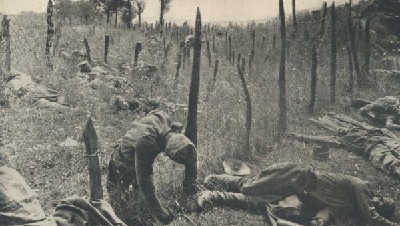
| The result of Russian "human wave" tactics |
His fellow generals were slow and hesitant in the follow-up and the Russian army soon reverted to the "human wave" tactic with catastrophic losses. During the summer and autumn, the offencive petered out; Germany moved in reinforcements from the West to stiffen up the wobbling Austrians and the front was stabilised. The Dual Monarchy was saved for now, but the cost was frightening. Hundreds of thousands of soldiers were killed, captured and “missing”. No doubt many of the missing later joined the
Czechoslovak Army Corps. Russia lost a staggering one million men in dead, wounded and captured. These losses on top of the disasters of 1915 seriously undermined morale and eventually contributed to the collapse and revolutions of 1917. In other areas the Brusilov offensive was also important; it may have saved the allies in France and Italy and also persuaded Romania to enter the war.
THE END OF THE ROMANOV DYNASTY
 |
| Petrograd in turmoil, March 1917 |
The winter of 1916-1917 was relatively quiet on the Eastern front, as none of the exhausted parties took any major initiatives. The front was established along the
Stochod river down to
Dorna Vatra in the Romanian Carpathians. Territorially Russia was better off than a year before but the internal fabric was crumbling with protests, hunger marches and strikes commonplace. On 8 March*) 1917 the revolution started and a within a week Nicholas II was forced to resign (here is his
letter of resignation). Russia was the first of the four large autocratic WW1 belligerents to collapse, and it was to have far reaching consequences, not only for the immediate future, but also for the rest of the 20th century.
SOURCES
The information contained in this entry is largely based on "Za svobodu", a four-volume illustrated history of the Czechoslovak Revolutionary Movement in Russia from 1914 to 1920. Further, books by František Langer, Victor M. Fic and Jaroslav Křížek. To a lesser degree Norman Stone, Radko Pytlík and Cecil Parrott, have been consulted.




 Posts
Posts

